_edited.png)
Housing NOW Releases a Free Bamboo Construction Manual Built for Myanmar’s Displacement Frontline
July 16, 2026
The field manual rejects standardized shelter design and transfers practical construction knowledge directly to the communities rebuilding under conflict, disaster, and collapsing supply chains.

YANGON, Myanmar — Housing NOW has released a free, open-access Bamboo Construction Manual designed specifically for local carpenters and communities rebuilding their homes in displacement settings across Myanmar.
It is not a handbook for governments. It is not a training curriculum for humanitarian staff. It is not a catalogue of prefabricated shelters. It is a field tool for the people doing the building.
Myanmar is living through overlapping crises: prolonged armed conflict, mass displacement, destructive floods and heat, the March 2025 earthquake, restricted movement, unstable material prices, and increasingly unreliable supply chains. In many affected areas, outside construction teams cannot travel safely. Industrial materials are unaffordable or unavailable. Electricity, machinery, transport, and specialist engineering support cannot be assumed.
Yet construction continues. Families repair damaged houses. Local carpenters rebuild shelters. Villages organize labor, locate materials, and adapt whatever knowledge and resources remain within reach.
The Housing NOW Bamboo Construction Manual was developed for this reality.
From Delivering Houses to Transferring Control
Housing NOW is a field-based bamboo construction company operating in Myanmar. It designs and builds low-cost housing, schools, clinics, and community infrastructure under severe logistical, economic, and political constraints.
Blue Temple is an architecture studio focused on design research, experimental construction, and the development of alternative building systems. Working together, the two organizations have spent years testing how architectural and engineering knowledge can remain useful when funding, machinery, imported materials, and stable institutions are absent.
Housing NOW’s approach has evolved through three distinct phases.
The first was prefabrication: engineered bamboo frames produced in Bago, transported to crisis-affected areas, and assembled rapidly with local teams. Prefabrication improved speed, repeatability, material control, and structural performance during emergency response.
The second was community-driven reconstruction. As conflict intensified and mobility became more dangerous, centralized construction became increasingly difficult. Housing NOW began working through decentralized village teams, supporting households with procurement, funding, technical standards, and structural advice while allowing each family to adapt its own house.
The manual represents the third and most radical step: transferring the knowledge itself.
Instead of expanding an external construction operation indefinitely, Housing NOW is making itself less necessary. The objective is to help communities strengthen the houses they are already building, using the materials, tools, labor, and knowledge they already possess.

“The most resilient construction system is not the one that depends permanently on us,” said Housing NOW co-founder Raphaël Ascoli. “It is the one that communities can understand, adapt, repair, and continue using after we leave.”
No Universal House
The manual does not promote a single Housing NOW house design. Housing NOW rejects the idea that one shelter can be designed once and replicated across every village, climate, culture, hazard, and supply chain. There is no universal house, no “unicorn” prototype capable of solving every housing crisis.
A house appropriate for a flood-prone delta is not automatically appropriate for a mountainous conflict area. A connection that works with one bamboo species may be unsuitable for another. A construction method that depends on electricity, imported fasteners, or specialized machinery may become useless several kilometres beyond a functioning road.
Every context requires new decisions.
For this reason, the manual focuses on methods rather than products. It breaks construction down into practical decisions concerning bamboo clump management, harvesting, preservation, drying, storage, foundations, structural frames, joints, floors, walls, roofing, repair, and long-term maintenance.
For many of these decisions, it presents several options rather than one prescribed answer.
Communities can select techniques according to the bamboo species available locally, the condition of the soil, the tools within the village, access to water, available labor, existing craftsmanship, transport limitations, and the materials that can realistically be obtained. The final building remains the community’s responsibility and the community’s design.

The manual does not replace local knowledge. It assumes that knowledge already exists.
Myanmar has a deep vernacular bamboo-building culture. Many local carpenters already know how to select culms, prepare members, construct floors, tie frames, and repair houses. The manual does not begin by explaining bamboo to them. It introduces targeted improvements that can make existing practices more durable, structurally reliable, and easier to maintain.
Built for One Context, Not Exported as a Formula
The manual has been deliberately filtered for the specific conditions of displaced and vulnerable communities in Myanmar.
It assumes limited funding. It assumes uneven access to electricity. It assumes industrial products may be difficult to find. It assumes communities already possess some practical knowledge of bamboo construction. It assumes that the most technically advanced solution is often irrelevant if it cannot be repaired locally. This specificity is fundamental to the project.
Although the principles may inform work elsewhere, the publication should not be copied uncritically into another country or humanitarian context. Different bamboo species, hazards, climates, cultural practices, construction skills, regulations, and supply chains would require the manual to be reviewed and redesigned.
Housing NOW does not consider context-specificity a limitation. It considers it a condition of responsible design.
The manual is currently distributed digitally and physically (2000 hard copies distributed) through UNHCR Shelter Cluster partners, who provide access to communities in displacement settings. Humanitarian organizations serve as distribution channels. They are not the manual’s primary users.
The end users are the carpenters, households, and community builders making decisions directly on construction sites.
A Manual Backed by Buildings
The manual is not based on an isolated research exercise. It emerges from years of construction, prototyping, testing, failure, repair, and adaptation across housing, education, community infrastructure, and healthcare projects in Myanmar.
Housing NOW has now completed three bamboo clinics in Puta-O, Thanlyin, and Hlaing Thar Yar. All three are operating and together support healthcare programs delivering approximately 200,000 consultations annually.
These buildings demonstrate that bamboo is not restricted to temporary emergency shelter. It can form part of permanent, heavily used public infrastructure when material selection, preservation, detailing, exposure, maintenance, and local construction capacity are treated seriously.
Each clinic required a different construction strategy.
In remote Putao, where conflict, landslides, and transport constraints made dependence on external supply chains impossible, most materials were sourced from the immediate area and the bamboo came from a neighboring plantation. The building was constructed in situ with local timber carpenters and Housing NOW’s bamboo team.
In Thanlyin and Hlaing Thar Yar, selected components could be prefabricated in Bago while the remaining work was carried out locally.
The lesson was not that one method was superior. The lesson was that construction systems must change when the conditions change. That same principle shapes the manual.
Innovation Without Spectacle
Construction innovation is frequently associated with expensive machines, robotics, digital fabrication laboratories, proprietary products, and technologies accessible to only a small number of specialists.
Housing NOW takes a different position.
Some of the most consequential innovation happens where there is almost no research funding, limited electricity, unstable transport, and no possibility of replacing an entire material culture with an imported system.
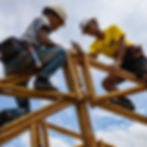
In these conditions, innovation may mean modifying a joint so that bamboo splits less often. It may mean improving drainage around a footing. It may mean selecting a treatment method that a village can actually reproduce. It may mean offering three technically viable options rather than prescribing one ideal solution that is impossible to implement.
These interventions may appear modest, but their reach can be far greater than technologies designed for a small, highly capitalized market.
“Low-tech does not mean low intelligence,” Ascoli said. “Designing under extreme scarcity requires precision. The solution must work with the tools people have, the material growing nearby, and the knowledge already present in the community. Otherwise, it is not innovation. It is a demonstration.”
Knowledge That Fits in a Pocket
The manual condenses 18 months of research and field testing into a two-page A3 laminated sheet that folds to pocket size. Its format is intentional.
It is designed to be carried on construction sites, opened in ahttp://shelter.It village, discussed between carpenters, exposed to dirt and handling, and consulted while decisions are being made. It is not intended to remain in an office, be absorbed into an institutional report, or become another document that never reaches the people named as its beneficiaries.
By releasing the manual freely, Housing NOW is arguing for a different measure of success.
The objective is not to maximize the number of buildings controlled by one organization. It is to increase the number of people capable of making better construction decisions without that organization.

The future of resilient housing in Myanmar will not be delivered by a single company, donor, technology, or standardized shelter. It will be built village by village, by people working with what remains available to them.
The purpose of the manual is to put stronger methods in their hands.

Welcome to World Bamboo News & Events. Stay updated with the latest industry news, event highlights, and expert insights. Explore innovations, policy updates, and global happenings shaping the future of bamboo.


News & Events
Connecting the Global Bamboo Community